Home » Varicose Veins: Causes, Stages and Modern Laser Treatment Explained
Varicose veins are more than a cosmetic concern for many people. They often come with a heaviness that gradually rises through the day, causes occasional night cramps, and in some cases, genuine discomfort that constrains daily activity. Understanding why varicose veins develop and how they progress helps explain why treating them early tends to produce better, easier results than waiting.
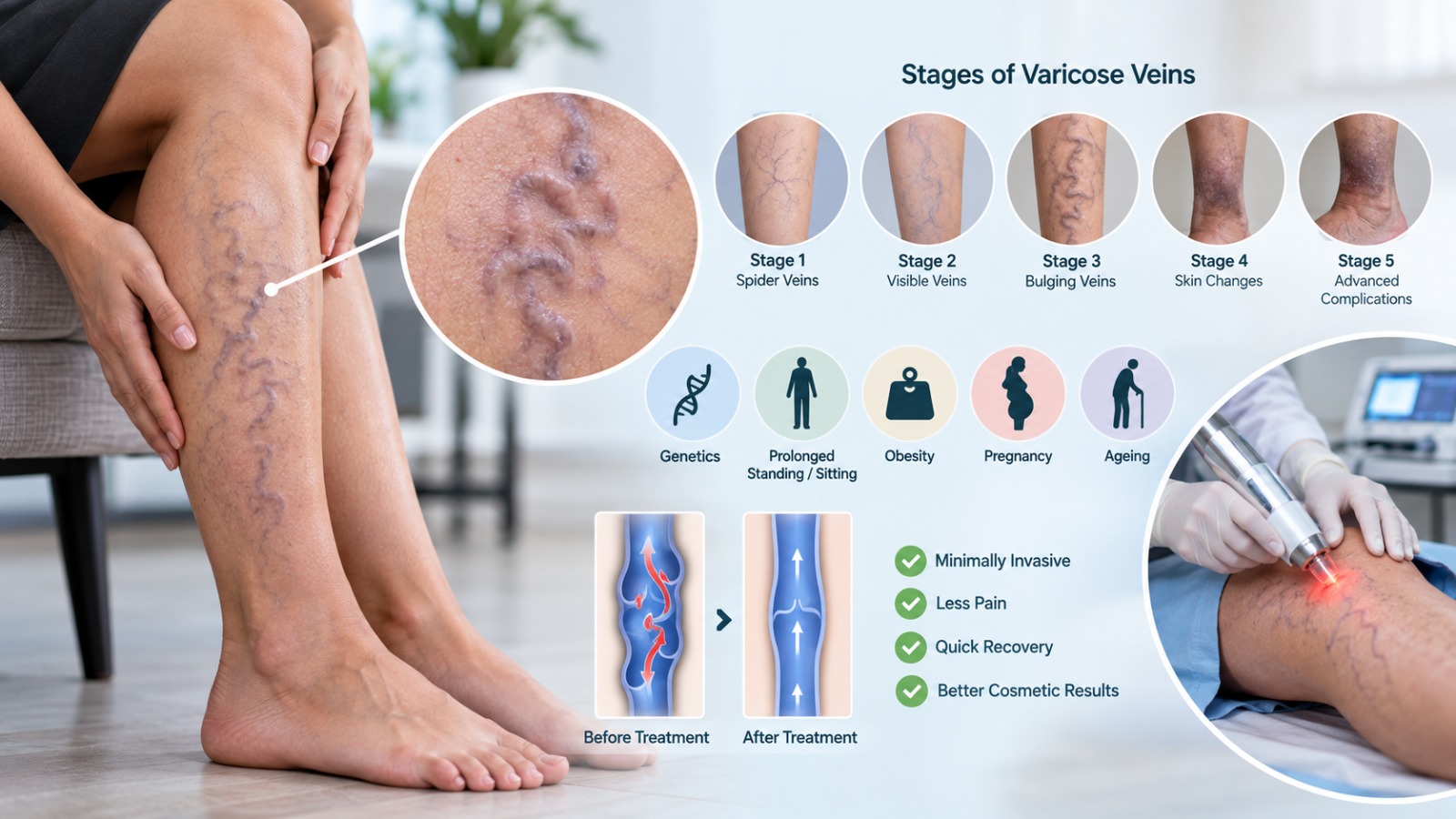
Veins carry blood back to the heart using one-way valves that prevent blood from flowing backward. Varicose veins develop when these valves weaken or fail, allowing blood to pool in the vein instead of flowing efficiently upward. Over time, this pooling causes the vein to stretch, bulge, and take on the twisted, rope-like appearance most people associate with the condition.
| Stage | What Happens | Typical Approach |
|---|---|---|
| Early | Spider veins or mild visible veins, minimal symptoms | Lifestyle changes, compression stockings |
| Moderate | More visible bulging veins, aching, heaviness | Compression, and laser treatment considered if symptomatic |
| Advanced | Persistent swelling, skin changes, discomfort affecting daily life | Laser or surgical treatment generally recommended |
| Complicated | Skin ulcers, clotting, or significant skin changes near the ankle | Prompt medical treatment needed |
Not every case progresses through every stage, and how quickly progression happens varies significantly by individual, but the general pattern is that varicose veins tend to slowly worsen rather than improve without intervention.
While many cases remain a manageable cosmetic and comfort issue, untreated varicose veins can, in some cases, progress to more significant problems, including skin changes around the ankle, or in rarer cases, blood clots or venous ulcers. These complications are far less common than the milder symptoms most patients experience, but they are part of why consistently rising symptoms deserve a proper evaluation rather than being managed indefinitely with home remedies.
A Doppler ultrasound is the standard way to evaluate varicose veins, since it shows exactly how blood is flowing through the veins and identifies which valves are not working properly. This painless, non-invasive scan helps determine the most appropriate treatment approach for your specific case, rather than treatment being based on appearance alone.
Compression stockings apply pressure to the legs, helping in supporting vein function and reduce pooling. They can meaningfully ease symptoms like heaviness and mild swelling, particularly in earlier stages, but it is worth being clear that compression stockings manage symptoms rather than fix the underlying valve problem. For veins that have already become visibly enlarged, stockings alone typically will not reverse the appearance.
Modern laser treatment, known as endovenous laser ablation, offers a minimally invasive alternative to traditional vein stripping surgery. Instead of a large incision, a thin laser fiber is inserted into the affected vein through a small access point, and laser energy is used to seal the vein shut, redirecting blood flow to healthier veins nearby.
Someone in a standing profession begins noticing evening leg heaviness and mild ankle swelling in their thirties, initially managing it with over the counter compression socks. Over a few years, visible veins develop, and the heaviness starts affecting their ability to work comfortably through a full shift. A Doppler scan confirms valve failure in specific veins, and laser treatment is recommended given the stage. The procedure itself takes under an hour, and within a few days, they return to normal activity, a much smoother path than they expected going into the consultation.
Recovery from laser vein treatment is typically quicker than many patients anticipate. Most people can walk the same day and resume light activity within a short period, though your surgeon will provide specific guidance based on your procedure. This aligns with the broader pattern seen across minimally invasive procedures, which you can read more about in our laparoscopic vs open surgery comparison.
Book a confidential consultation with the Dermatology team at Yutika Hospital for an accurate diagnosis and a customized treatment plan.
Most patients report only mild discomfort during the procedure, particularly since it is typically performed under local anaesthesia. Some mild bruising or tightness in the treated area afterward is common and generally resolves within a short period.
Varicose veins are a progressive condition, and earlier evaluation generally means simpler, more comfortable treatment options. Yutika Hospital’s surgical team uses Doppler evaluation to understand exactly what is happening in your veins before recommending a treatment plan, including modern laser treatment where appropriate. Learn more on our varicose veins and varicocele treatment page.
Varicose veins tend to progress gradually, which means the earlier they are evaluated, the more options remain available, often including a minimally invasive laser approach rather than more involved surgery. If bulging veins, heaviness, or swelling have been building over time, a Doppler evaluation is the clearest way to understand exactly what is happening and what treatment actually fits your stage.
If leg vein symptoms have been affecting your comfort or daily activity, book a consultation with our surgical team for a proper evaluation.
This article is intended for educational and informational purposes only and should not be considered medical advice, diagnosis, or treatment. Every individual’s health condition is unique. Always consult a qualified healthcare professional for personalized medical guidance. Do not ignore or delay seeking professional medical advice based on information provided in this article. If you are experiencing a medical emergency, seek immediate medical attention or contact your local emergency services.

Yutika Hospital is a trusted multi-speciality hospital in Tirupati offering advanced general surgery and dermatology treatments. We focus on accurate diagnosis, effective treatment, and personalized patient care.
Need more help?
Email support
2-120A, Rd Number 2, M.K. Naidu Colony, Lingeswar Nagar, Bairagi patteda, Tirupati, Andhra Pradesh 517501
Best Hospital in Tirupati for General Surgery & Dermatology Treatments
© 2026 Yutika Hospital, Tirupati. All Rights Reserved.