
Home » Laparoscopic vs Open Surgery: Benefits Compared | Yutika
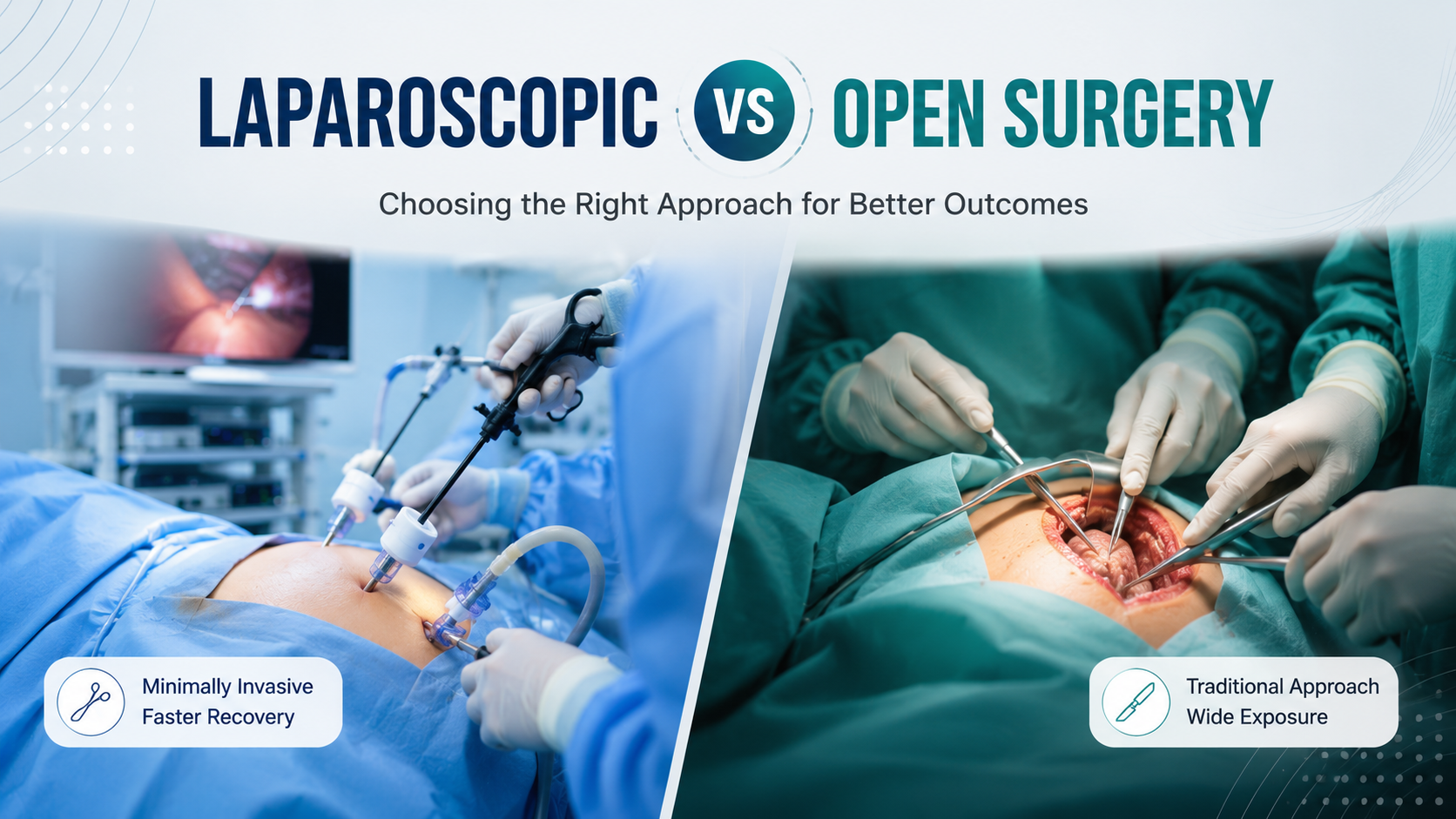
If your doctor has recommended surgery, one of the first questions worth asking is whether it can be done laparoscopically. The two approaches, laparoscopic and open surgery, can treat many of the same conditions, but they differ significantly in incision size, recovery time, and how soon you get back to normal life. This article breaks down the real differences so you can have a more informed conversation with your surgeon.
Laparoscopic surgery, sometimes called keyhole surgery, is performed through a few small incisions rather than one large cut. A thin camera, called a laparoscope, is inserted through one incision to give the surgeon a clear view of the internal area on a screen, while specialized instruments are used through the other small incisions to perform the procedure.
Open surgery involves a single, larger incision that gives the surgeon direct access to the area being treated. It is the traditional surgical approach and remains necessary for certain complex cases where laparoscopic access is not suitable or safe.
| Factor | Laparoscopic Surgery | Open Surgery |
|---|---|---|
| Incision size | A few small cuts, usually under 1 to 1.5 cm each | One larger incision |
| Post operative pain | Generally less | Generally more |
| Hospital stay | Often shorter, sometimes same day | Often longer, several days |
| Recovery to normal activity | Faster, often 1 to 2 weeks | Slower, often 3 to 6 weeks |
| Visible scarring | Minimal | More noticeable |
| Suitability | Most standard cases | Complex or high risk cases, or when laparoscopic access is not safe |
Laparoscopic technique is now used across a wide range of general surgery procedures, including several treated at Yutika Hospital.
Not every case of every condition is automatically suitable for laparoscopic surgery. Factors like the size and complexity of the problem, previous abdominal surgeries, and overall health all play a role in what your surgeon recommends.
The benefits of laparoscopic surgery are not just cosmetic. Smaller incisions mean less trauma to the surrounding tissue and muscle, which is the direct reason recovery tends to be faster and less painful. Less trauma also generally means a lower risk of certain complications, such as wound infections, though every surgery carries some risk regardless of technique.
Despite its advantages, laparoscopic surgery is not automatically the right choice for every patient or every case. Open surgery may be recommended when:
A good surgeon will explain clearly why one approach is being recommended over the other for your specific case, rather than defaulting to either option automatically.
Consider two patients, both diagnosed with gallstones. One has straightforward, uncomplicated gallstones and is a good candidate for laparoscopic cholecystectomy, likely going home the same day or the next, with a return to light activity within a week or two. The other has a history of significant abdominal scarring from a previous surgery, which makes laparoscopic access more difficult and riskier. For this second patient, open surgery may actually be the safer, more appropriate choice, even though it involves a longer recovery. The right technique depends entirely on the individual case, not a fixed rule.
Laparoscopic surgery often has a somewhat higher procedure cost than open surgery, largely due to the specialized equipment involved. However, when you factor in a shorter hospital stay, fewer missed work days, and less need for extended pain management, the total cost difference is often smaller than it first appears. Your surgical team can walk you through a clear cost breakdown for your specific case during consultation.
Book a confidential consultation with Yutika Hospital for an accurate assessment and a customized treatment plan.
Yutika Hospital’s general surgery team evaluates each case individually to determine whether a laparoscopic approach is appropriate, rather than applying a one size fits all recommendation. Whether you are considering treatment for a hernia, gallbladder stones, appendicitis, or piles, your surgeon will walk you through exactly why a particular technique is being recommended for your specific situation. You can explore our approach to minimally invasive procedures on the laparoscopic surgery page.
Laparoscopic and open surgery are not competing options where one is always better. Each has a role depending on the specific condition, its complexity, and individual patient factors. The most useful step is an honest conversation with your surgeon about which approach fits your case and why, rather than assuming either technique automatically applies.
If you have been advised to undergo surgery and want to understand whether a laparoscopic approach is right for you, book a consultation with our surgical team.
This article is intended for educational and informational purposes only and should not be considered medical advice, diagnosis, or treatment. Every individual’s health condition is unique. Always consult a qualified healthcare professional for personalized medical guidance. Do not ignore or delay seeking professional medical advice based on information provided in this article. If you are experiencing a medical emergency, seek immediate medical attention or contact your local emergency services.

Yutika Hospital is a trusted multi-speciality hospital in Tirupati offering advanced general surgery and dermatology treatments. We focus on accurate diagnosis, effective treatment, and personalized patient care.
Need more help?
Email support
2-120A, Rd Number 2, M.K. Naidu Colony, Lingeswar Nagar, Bairagi patteda, Tirupati, Andhra Pradesh 517501
Best Hospital in Tirupati for General Surgery & Dermatology Treatments
© 2026 Yutika Hospital, Tirupati. All Rights Reserved.