
Home » Hydrocele in Adults: Causes, Symptoms and When Surgery Is Needed
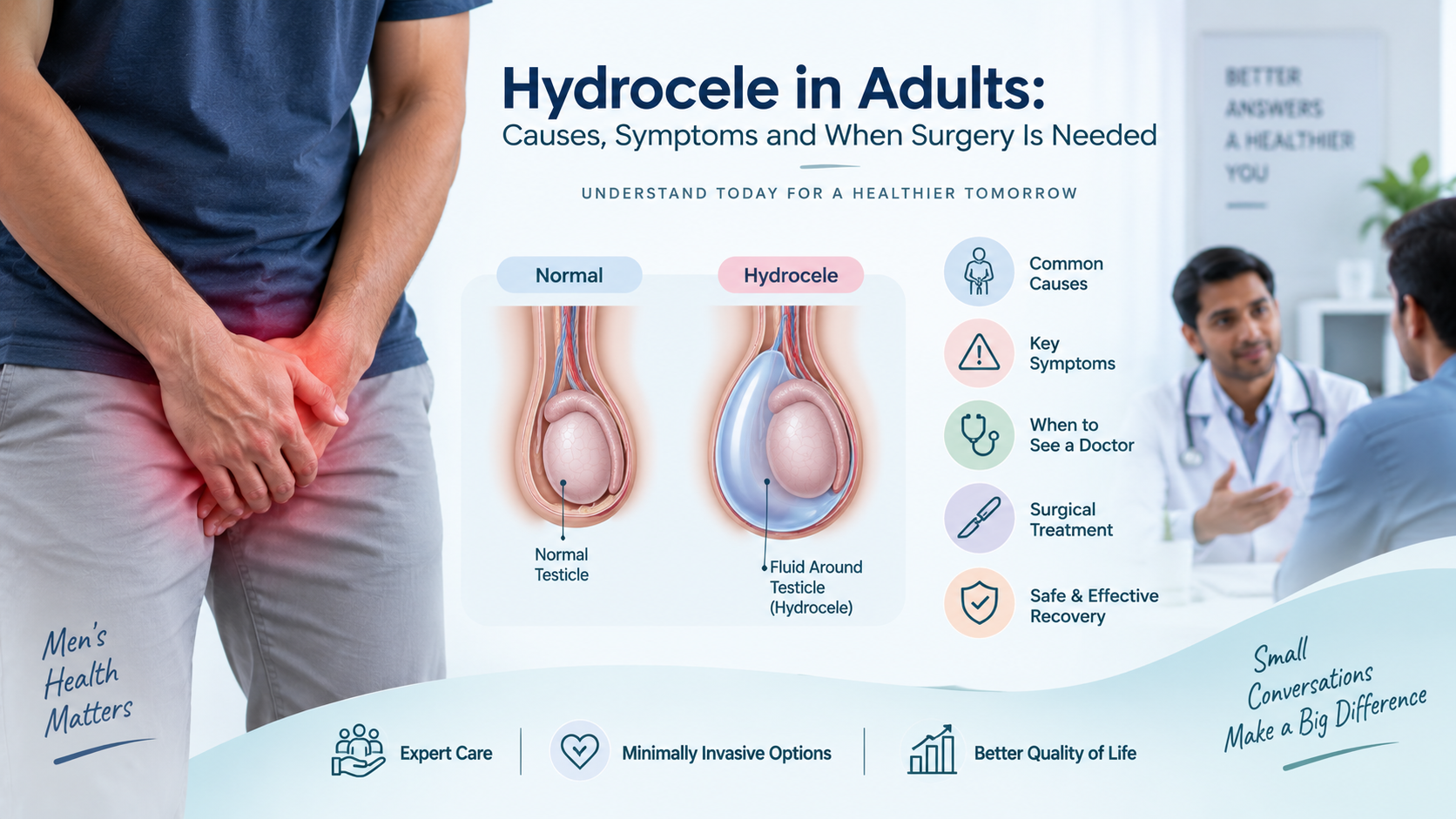
Noticing swelling in the scrotum is understandably worrying, and for many men, embarrassment delays a visit to the doctor far longer than it should. A hydrocele is one of the most common causes of this kind of swelling, and the reassuring news is that it is usually painless, not dangerous, and very treatable once properly diagnosed.
A hydrocele is a fluid-filled sac that forms around the testicle, causing the scrotum to swell. It happens when fluid accumulates in the thin sheath that surrounds the testicle, and while it is more commonly discussed in newborns, it is a common condition in adult men too.
This difference matters because these conditions look similar on the surface but need different approaches. A hydrocele is generally painless and feels smooth, often described as feeling like a small water balloon. A hernia, by contrast, may involve a bulge that changes size with straining or coughing, and can sometimes cause discomfort. Other causes of scrotal swelling, including certain infections or, in rarer cases, a testicular mass, need to be distinguished through a proper examination rather than assumed based on appearance.
Small, stable hydroceles that are not causing discomfort or affecting daily life are sometimes simply monitored, particularly if there is no clear underlying cause requiring treatment. Your surgeon will confirm through examination and, often, an ultrasound whether observation is a reasonable approach for your specific case.
Diagnosis typically starts with a physical examination, where a hydrocele often allows light to pass through it in a simple test called transillumination, a standard ign that distinguishes it from solid masses. An ultrasound is commonly used to confirm the diagnosis and rule out other causes of scrotal swelling.
The surgical treatment for hydrocele, called a hydrocelectomy, involves removing or repairing the sac causing the fluid buildup. It is a well-established, routine procedure in general surgery, often performed as day care surgery, meaning many patients go home the same day. Many hydrocele procedures, along with related conditions like hernia, are increasingly performed using laparoscopic technique, which you can read more about in our laparoscopic surgery comparison.
A man in his forties notices gradual scrotal swelling over several months but delays seeing a doctor for nearly a year out of embarrassment, quietly worried that it might be something serious. When he finally has it evaluated, an ultrasound confirms a straightforward hydrocele with no other underlying concern. The hydrocelectomy is completed as day care surgery, and he returns to normal activity within about two weeks. Looking back, the year of quiet worry was the hardest part of the entire experience, not the treatment itself, which is an experience many patients describe once they finally seek care.
Most patients experience mild swelling and discomfort for the first few days, managed with prescribed pain relief. Light activity is usually possible within a few days, with a full return to normal activity, including more strenuous exercise, typically within two to three weeks, depending on individual healing.
A simple, uncomplicated hydrocele generally does not affect fertility. If there is an underlying cause contributing to the hydrocele that could also affect fertility, this would be identified and discussed separately during your evaluation.
Recurrence after proper surgical treatment is uncommon, though it can happen in a small percentage of cases. Following your surgeon’s post-operative guidance supports the best long-term outcome.
This is worth addressing directly: scrotal swelling is one of the most commonly evaluated conditions in general surgery, and doctors approach it with the same professionalism as any other consultation.
Delaying care due to embarrassment does not make the condition go away. It simply means living with unnecessary worry and, in some cases, allowing a treatable condition to become larger and more prominent than it needed to be.
If you would like a personalised laser hair removal quote based on your specific skin and hair type, book a consultation with our dermatology team.
Scrotal swelling deserves a prompt, confidential evaluation rather than months of quiet worry. Yutika Hospital’s general surgery team diagnoses and treats hydrocele with discretion and clarity, explaining exactly what is happening and what your options are. Learn more on our hydrocele treatment page.
A hydrocele is one of the most straightforward, treatable conditions in general surgery, and the swelling itself is rarely as concerning as the worry that often builds up while waiting to get it checked. An examination and, if needed, an ultrasound quickly clarifies what is happening and what your realistic options are.
If you have noticed scrotal swelling, book a confidential consultation with our surgical team.
This article is intended for educational and informational purposes only and should not be considered medical advice, diagnosis, or treatment. Every individual’s health condition is unique. Always consult a qualified healthcare professional for personalized medical guidance. Do not ignore or delay seeking professional medical advice based on information provided in this article. If you are experiencing a medical emergency, seek immediate medical attention or contact your local emergency services.

Yutika Hospital is a trusted multi-speciality hospital in Tirupati offering advanced general surgery and dermatology treatments. We focus on accurate diagnosis, effective treatment, and personalized patient care.
Need more help?
Email support
2-120A, Rd Number 2, M.K. Naidu Colony, Lingeswar Nagar, Bairagi patteda, Tirupati, Andhra Pradesh 517501
Best Hospital in Tirupati for General Surgery & Dermatology Treatments
© 2026 Yutika Hospital, Tirupati. All Rights Reserved.