Home » Laser Skin Treatment for the Face: Types, Sessions, Results and Safety for Indian Skin
Laser treatments are now offered everywhere, from hospitals to beauty salons, promising clearer skin, faded spots and smoother scars. For many people, the questions are practical: Will it work for my problem? Is it safe for darker Indian skin? How many sessions will I need, and what will my face look like afterwards?
Lasers can produce excellent results when the right laser is chosen for the right concern and used with care. Used incorrectly, they can cause burns or leave skin darker than before. This guide explains how laser skin treatment works, what it can and cannot do, and how to get safe, realistic results.
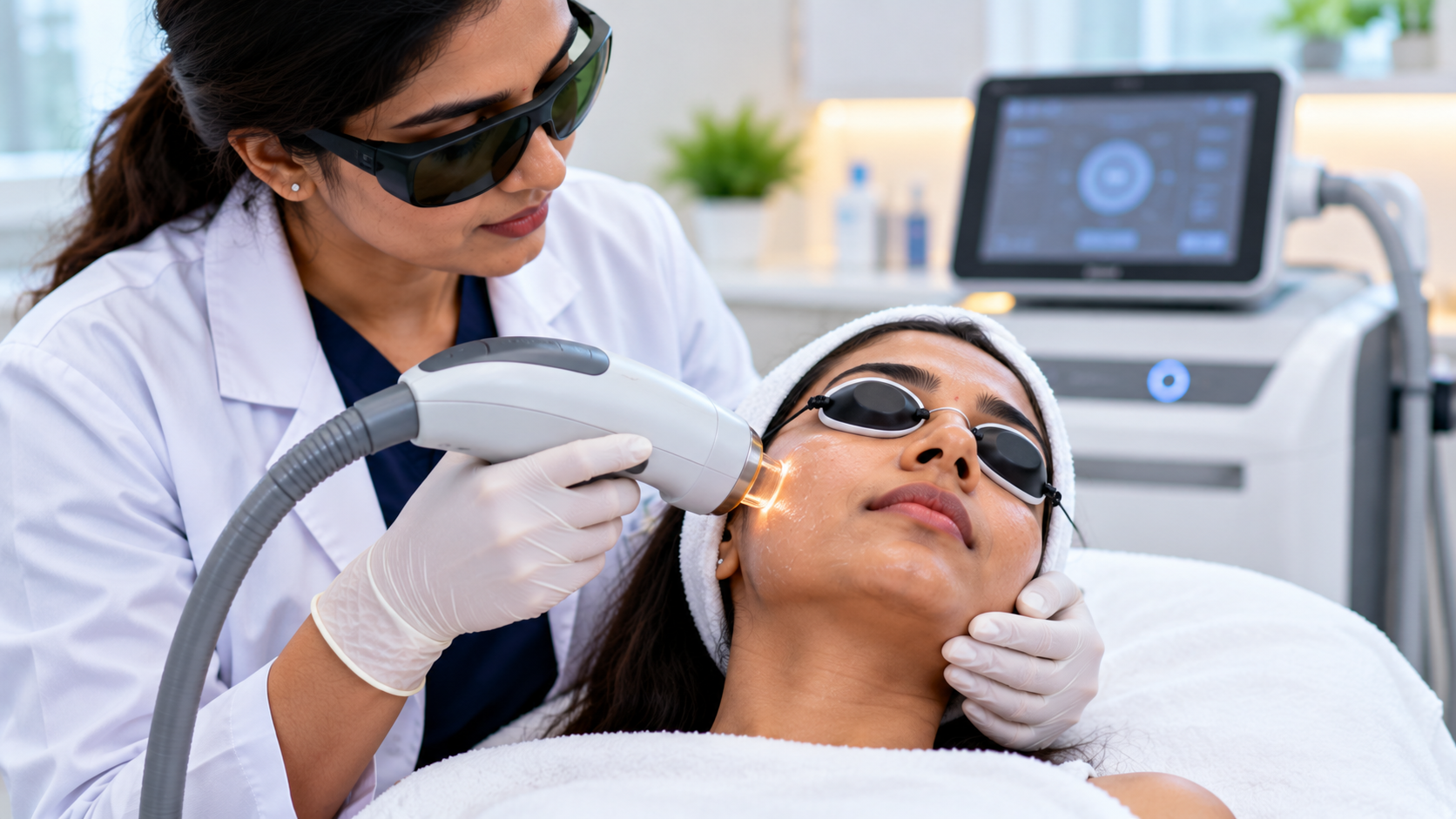
A laser produces a concentrated beam of light at a specific wavelength. Different wavelengths are absorbed by different targets in the skin, such as pigment (melanin), water or blood vessels. By choosing the right laser and settings, a dermatologist can break down excess pigment, stimulate new collagen to improve scars and texture, or target hair follicles, while leaving the surrounding skin largely unharmed. At Yutika Hospital, laser skin treatment is planned and supervised by our dermatology team for each patient’s skin type and concern.
| Laser Type | How It Works | Commonly Used For |
|---|---|---|
| Q-switched Nd:YAG | Very short pulses break pigment into tiny particles that the body clears | Sun spots, freckles, certain types of pigmentation, laser toning, tattoo removal |
| Picosecond laser | Even shorter pulses that break pigment with less heat | Pigmentation, tattoos, and some types of scars and texture concerns |
| Fractional CO2 laser (ablative) | Creates tiny columns of controlled injury that trigger new collagen | Acne scars, deeper wrinkles, rough texture; more downtime |
| Fractional non-ablative laser | Heats deeper layers without removing the surface | Mild scars, texture and open pores; less downtime |
| Diode or long-pulsed Nd:YAG | Targets pigment in hair follicles | Hair reduction |
The exact laser recommended depends on your skin type, your concern and the equipment available. A good dermatologist will explain why a particular laser is right for you.
For acne scars, lasers are one of several options. Our comparison of acne scar treatments, including microneedling, peels and lasers, explains which works best for different scar types.
Melasma, the brown patches commonly seen on the cheeks and forehead, especially in women, is sensitive to heat and light. Aggressive laser treatment can make it worse. Melasma is usually treated first with prescription creams, strict sun protection and, in some cases, chemical peels, with gentle laser settings considered only in selected cases. Our guide to melasma and facial pigmentation explains this in more detail.
Yes, when done correctly. Most Indian skin falls into Fitzpatrick skin types IV and V, which have more melanin. This means the skin is more likely to develop post-inflammatory hyperpigmentation, darkening that appears after any inflammation or injury, if a laser is too strong or used on tanned skin. Safe laser treatment for Indian skin involves:
This is also why medical lasers should be used under a dermatologist’s supervision, rather than as a quick salon add-on.
| Concern | Typical Number of Sessions | Usual Gap Between Sessions |
|---|---|---|
| Pigmentation and sun spots | 3 to 6 | 3 to 4 weeks |
| Acne scars (fractional laser) | 3 to 6 | 4 to 6 weeks |
| Skin rejuvenation and tone | 4 to 6 | 2 to 4 weeks |
| Hair reduction | 6 to 8 or more | 4 to 8 weeks |
These are general ranges. Your dermatologist will advise a plan based on your skin and how it responds. Results build gradually, with collagen-based improvements in scars continuing for several months after the final session.
Downtime depends on the type of laser. After pigment lasers or non-ablative lasers, mild redness usually settles within a few hours to a day, and treated spots may darken and flake off over a week. After fractional CO2 laser, redness, swelling and fine crusting usually last around five to seven days. To protect your results:
| Treatment | Best Suited For | Downtime |
|---|---|---|
| Laser treatment | Pigmentation, scars, texture and hair reduction, depending on the laser | Minimal to about a week |
| Chemical peel | Mild pigmentation, dullness, acne and fine texture | Minimal to a few days of peeling |
| Microneedling (derma roller) | Acne scars, open pores and texture | One to three days of redness |
These treatments are often combined for better results. Learn more about chemical peel treatment and derma roller therapy for acne scars.
The cost of laser skin treatment depends on the type of laser, the size of the area treated, the number of sessions required, and whether other treatments are combined. Instead of comparing per-session prices alone, compare what is included: a dermatologist’s diagnosis, the type of laser used, aftercare and follow-up. Very cheap packages that skip diagnosis or use aggressive settings can lead to complications that cost far more to correct. A consultation is the best way to get an accurate estimate for your skin.
A 29-year-old woman with acne scars has tried several “laser facials” at a salon without visible change. At a dermatology consultation, she learns that she has a mix of rolling and boxcar scars, and that her earlier sessions did not use a resurfacing laser. Her dermatologist plans a series of fractional laser sessions combined with microneedling, along with strict sun protection. Over the following months, her scars become noticeably softer and shallower, with no pigmentation problems. The difference was a correct diagnosis and the right laser.
If you would like a personalised laser hair removal quote based on your specific skin and hair type, book a consultation with our dermatology team.
Laser treatment is only as good as the diagnosis and care behind it. Yutika Hospital’s dermatology team assesses your skin type and concern, recommends the most suitable option, whether that is a laser, a peel or a combination, and uses settings chosen for Indian skin, with clear aftercare and follow-up. Learn more about our laser skin treatment in Tirupati.
Laser skin treatment can be very effective for pigmentation, acne scars and skin texture, but results depend on choosing the right laser for your skin and concern. For Indian skin, careful settings, skin preparation and sun protection are what separate good outcomes from complications. A dermatologist’s assessment is the safest place to start.
If you are considering laser treatment for pigmentation, scars or skin texture, book a skin assessment with our dermatology team.
This article is intended for educational and informational purposes only and should not be considered medical advice, diagnosis, or treatment. Every individual’s health condition is unique. Always consult a qualified healthcare professional for personalized medical guidance. Do not ignore or delay seeking professional medical advice based on information provided in this article. If you are experiencing a medical emergency, seek immediate medical attention or contact your local emergency services.

Yutika Hospital is a trusted multi-speciality hospital in Tirupati offering advanced general surgery and dermatology treatments. We focus on accurate diagnosis, effective treatment, and personalized patient care.
Need more help?
Email support
2-120A, Rd Number 2, M.K. Naidu Colony, Lingeswar Nagar, Bairagi patteda, Tirupati, Andhra Pradesh 517501
Best Hospital in Tirupati for General Surgery & Dermatology Treatments
© 2026 Yutika Hospital, Tirupati. All Rights Reserved.