
Home » Appendicitis Warning Signs You Should Never Ignore
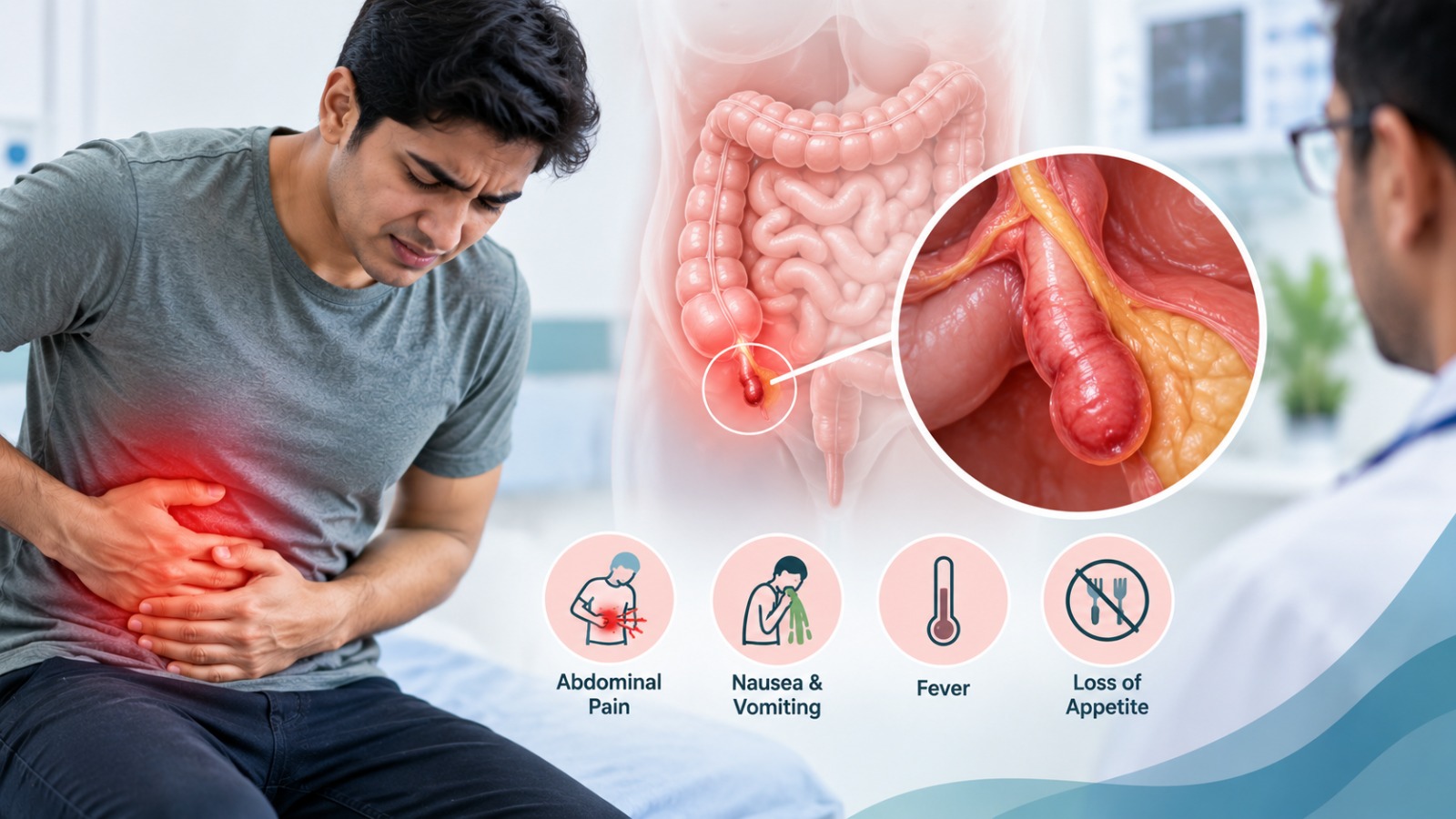
Abdominal pain is a common customer that most people brush off as gas, indigestion, or something they ate. But appendicitis has a fairly recognizable pattern once you know what to look for, and recognizing it early matters, since this is one of the few general surgery conditions where a timely reaction can prevent a serious complication.
The appendix is a small, finger-shaped pouch attached to the large intestine, on the lower right side of the abdomen. Its exact function in the body is not fully understood, but when it faces blockage and inflammation, the resulting condition, appendicitis, needs immediate medical recourse.
One of the most recognizable features of appendicitis is the pain pattern. It often starts as a slight discomfort around the belly button or upper abdomen, and over several hours, shifts and settles into the lower right side of the abdomen, becoming sharper and more localized. This migration of pain, from mild and central to sharp and specific, is one of the clearest signals that demarcates appendicitis from an ordinary stomach upset.
| Feature | Appendicitis | Gas Pain or Food Poisoning |
|---|---|---|
| Pain location | Starts central, moves to lower right | Usually more generalized or crampy |
| Pain pattern | Progressively worsens over hours | Often comes in waves, may ease with passing gas or a bowel movement |
| Fever | Often present, low-grade | Uncommon unless infection is present |
| Movement | Pain worsens with movement or pressure | Less consistently affected by movement |
| Duration | Steadily worsens rather than improving | Often improves within a few hours |
If pain is steadily worsening rather than coming and going, and especially if it has settled into the lower right abdomen, this is not a pattern to wait out at home.
Children can have a less classic presentation than adults, sometimes with more generalized abdominal pain, irritability, and reluctance to move or walk normally, rather than clearly localized pain. Because children may struggle to describe exactly where or how the pain feels, parents should take any combination of abdominal pain, fever, and loss of appetite seriously rather than waiting for a conventional symptom pattern to emerge.
Appendicitis typically develops over 12 to 48 hours after the first symptoms, though this can vary. The concern is that as time passes without treatment, the risk of the appendix rupturing increases significantly. This is why appendicitis is treated as a time-sensitive condition rather than something to monitor for days before deciding to approach a medical professional.
If appendicitis is left untreated, the inflamed appendix can rupture which can spread the infection into the abdominal cavity. This leads to a more serious condition called peritonitis, which requires more extensive treatment and a longer recovery than a straightforward appendix removal would have needed. A ruptured appendix is a genuine medical emergency, which is precisely why early evaluation is strongly recommended.
Someone wakes up with mild discomfort around the belly button and assumes it is simply something they ate the night before. Through the day, the discomfort does not go away, and by evening it has settled into a sharp, specific pain on the lower right side, worse when walking or coughing. This progression, from vague and central to sharp and localized over the course of a day, is the exact pattern that should prompt an urgent evaluation rather than waiting to see if it resolves overnight.
Diagnosis typically involves a physical examination, where pressing on the lower right abdomen and releasing quickly often reproduces sharp pain, along with blood tests to check for signs of infection, and typically an ultrasound or CT scan to confirm the diagnosis and rule out other causes of abdominal pain.
Book a confidential consultation with the Dermatology team at Yutika Hospital for an accurate diagnosis and a customized treatment plan.
The standard treatment for appendicitis is surgical removal of the appendix, known as an appendectomy. This is commonly performed laparoscopically, through a few small incisions, which causes lesser pain and a faster recovery compared to traditional open surgery. You can read more about how laparoscopic surgery compares to open surgery on our detailed blog.
Recovery from a straightforward laparoscopic appendectomy is often faster than many people expect, with many patients returning to light activity within a week or two. Diet is typically reintroduced gradually over the first day or two after surgery, starting with liquids before returning to normal food.
In a few uncomplicated cases, antibiotics alone are used as an alternative to surgery, though this approach carries a real risk of the condition recurring later, sometimes requiring surgery anyway. Surgical removal remains the more established and definitive treatment for most cases of appendicitis.
Appendicitis is genuinely a same-day medical concern. If this symptom pattern matches what you or a family member is experiencing, seeking care at once is the safest choice.
Appendicitis needs fast, accurate diagnosis and prompt surgical care to avoid the risk of rupture. Yutika Hospital’s general surgery team is equipped both technologically and technically to evaluate and treat appendicitis with laparoscopic appendectomy performed to support a faster, more comfortable recovery. Learn more on our appendicitis treatment page.
Appendicitis has an easily recognisable attern, pain that starts vaguely and moves to the lower right abdomen, steadily worsening rather than easing. Recognizing this pattern and acting on it quickly is one of the most important things you can do, since this is a condition where a same-day evaluation genuinely reduces the risk of a more serious complication.
If you or a family member is experiencing this kind of abdominal pain, contact our team for prompt evaluation.
This article is intended for educational and informational purposes only and should not be considered medical advice, diagnosis, or treatment. Every individual’s health condition is unique. Always consult a qualified healthcare professional for personalized medical guidance. Do not ignore or delay seeking professional medical advice based on information provided in this article. If you are experiencing a medical emergency, seek immediate medical attention or contact your local emergency services.

Yutika Hospital is a trusted multi-speciality hospital in Tirupati offering advanced general surgery and dermatology treatments. We focus on accurate diagnosis, effective treatment, and personalized patient care.
Need more help?
Email support
2-120A, Rd Number 2, M.K. Naidu Colony, Lingeswar Nagar, Bairagi patteda, Tirupati, Andhra Pradesh 517501
Best Hospital in Tirupati for General Surgery & Dermatology Treatments
© 2026 Yutika Hospital, Tirupati. All Rights Reserved.