
Home » Eczema Flare-Ups: What Triggers Them and How to Actually Calm Them
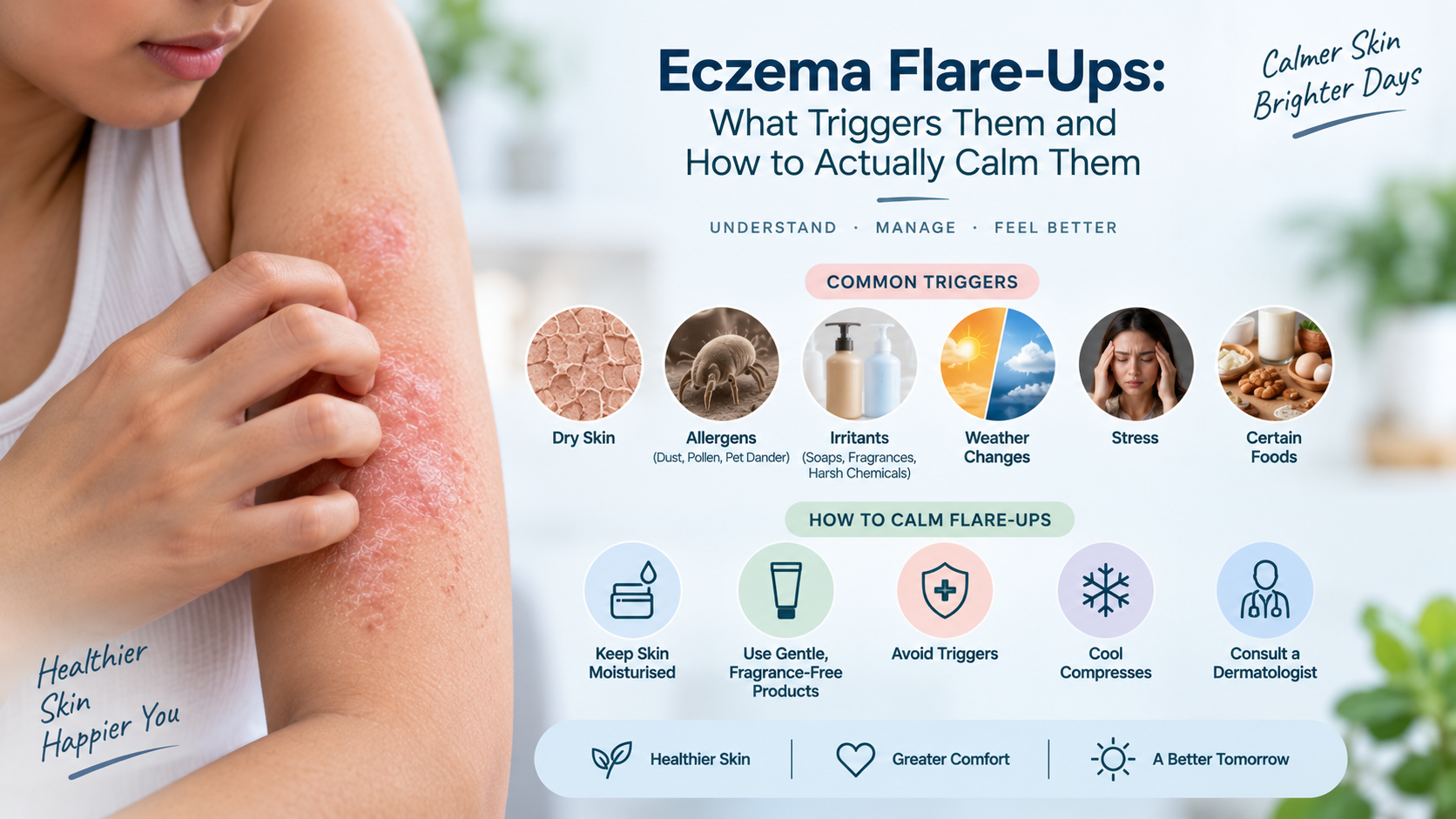
If you live with eczema, you already know the pattern: weeks of calm, manageable skin, followed by a sudden flare that seems to come out of nowhere. Except it rarely truly comes out of nowhere. Most flare-ups have identifiable triggers, and once you learn how to spot yours, managing eczema becomes far more easier.
Eczema- medically called atopic dermatitis, is a chronic condition where the skin barrier does not retain moisture as effectively as it should, making skin more prone to dryness, irritation, and inflammation. It is not contagious, and it often runs in families alongside other allergic conditions like asthma or hay fever.
Sweat, particularly during Tirupati’s warmer, humid months, is one of the most common and underestimated eczema triggers. The salt and moisture from sweat can irritate already sensitive skin, especially in skin folds.
Household dust, pollen, and pet dander can all trigger flare-ups in sensitive individuals, particularly during specific seasons.
Strong, fragranced soaps, and detergents used for washing clothes and bedding, are a very common but often overlooked trigger, since residue can remain on fabric and continue to irritate skin throughout the day.
Emotional stress does not directly cause eczema, but it is a well-recognized trigger for flare-ups in people who already have the condition, through its effect on the body’s inflammatory response system.
For some individuals, particular foods can trigger or worsen flare-ups, though this varies significantly by person and is not universal. Identifying a genuine food trigger usually benefits from professional guidance rather than broad, unsupervised elimination diets.
One of the most frustrating aspects of eczema is how scratching, while providing brief relief, actually worsens inflammation and can break the skin, increasing the risk of infection. This creates a cycle: itching leads to scratching, scratching worsens irritation, and worsened irritation leads to more itching. Breaking this cycle is often as important as addressing the original trigger.
Lukewarm water is preferable to hot water, which strips the skin’s natural oils and can worsen dryness. Keeping bathing time relatively short, and gently patting skin dry rather than rubbing, both help protect the skin barrier rather than further compromising it.
Topical steroids, when prescribed and used as directed by a dermatologist, are an effective and safe way to manage flare-ups. The concern arises with unsupervised, prolonged use of steroid creams obtained without a prescription, which can thin the skin and cause other side effects over time. Using a prescribed steroid cream appropriately, for the recommended duration is very different from indefinite, unsupervised use.
Eczema in children often appears on the face, scalp, and outer surfaces of the arms and legs, while in adults it more commonly affects the inner elbows, behind the knees, and hands. Many children see their eczema improve significantly as they get older, though some carry it into adulthood in a different pattern.
A parent notices their child’s eczema consistently worsens during the hotter months and initially assumes it is simply the heat in general. On closer tracking, the flares are actually most severe on days after swimming at a public pool, pointing to chlorine exposure as a specific, previously unrecognized trigger rather than heat alone. Adjusting post-swim rinsing and moisturizing routines meaningfully reduces the frequency of flares. This kind of specific trigger identification, rather than a vague sense of what is causing flares, is often the difference between ongoing frustration and real improvement.
Tracking when flares happen alongside recent activities, products used, weather, and stress levels can reveal patterns that are not obvious in the moment. This is one of the most practical tools for identifying your personal triggers, rather than pointing the blame at a single universal cause.
Eczema itself is not classified as an allergy, though it is closely linked to allergic conditions and often occurs alongside them. Some individual triggers may involve an allergic-type skin response, which is part of why identifying personal triggers matters more than treating eczema as one single, uniform condition.
Eczema is sometimes confused with psoriasis, another chronic skin condition with a different underlying cause and different typical locations on the body. Our psoriasis vs eczema blog walks through how to tell them apart.
Eczema is sometimes confused with psoriasis, another chronic skin condition with a different underlying cause and different typical locations on the body. Our psoriasis vs eczema blog walks through how to tell them apart.
If you would like a personalised laser hair removal quote based on your specific skin and hair type, book a consultation with our dermatology team.
Managing eczema well means understanding your specific triggers and having a proper skincare and treatment plan, not just reacting to each flare as it happens. Yutika Hospital’s dermatology team helps identify your patterns and builds a sustainable routine, with appropriately prescribed treatment for active flares. Learn more on our eczema treatment page.
Eczema flare-ups usually have identifiable triggers, even when they feel random in the moment. Building a consistent moisturizing routine, using prescribed treatment correctly, and tracking your specific patterns turns eczema management from a reactive struggle into something easily manageable.
If your eczema flare-ups are frequent or hard to manage, book a consultation with our dermatology team to build a plan suited to your skin.
This article is intended for educational and informational purposes only and should not be considered medical advice, diagnosis, or treatment. Every individual’s health condition is unique. Always consult a qualified healthcare professional for personalized medical guidance. Do not ignore or delay seeking professional medical advice based on information provided in this article. If you are experiencing a medical emergency, seek immediate medical attention or contact your local emergency services.

Yutika Hospital is a trusted multi-speciality hospital in Tirupati offering advanced general surgery and dermatology treatments. We focus on accurate diagnosis, effective treatment, and personalized patient care.
Need more help?
Email support
2-120A, Rd Number 2, M.K. Naidu Colony, Lingeswar Nagar, Bairagi patteda, Tirupati, Andhra Pradesh 517501
Best Hospital in Tirupati for General Surgery & Dermatology Treatments
© 2026 Yutika Hospital, Tirupati. All Rights Reserved.