
Home » Thyroid Swelling (Goitre): When Is It Serious and When Is Surgery Needed?
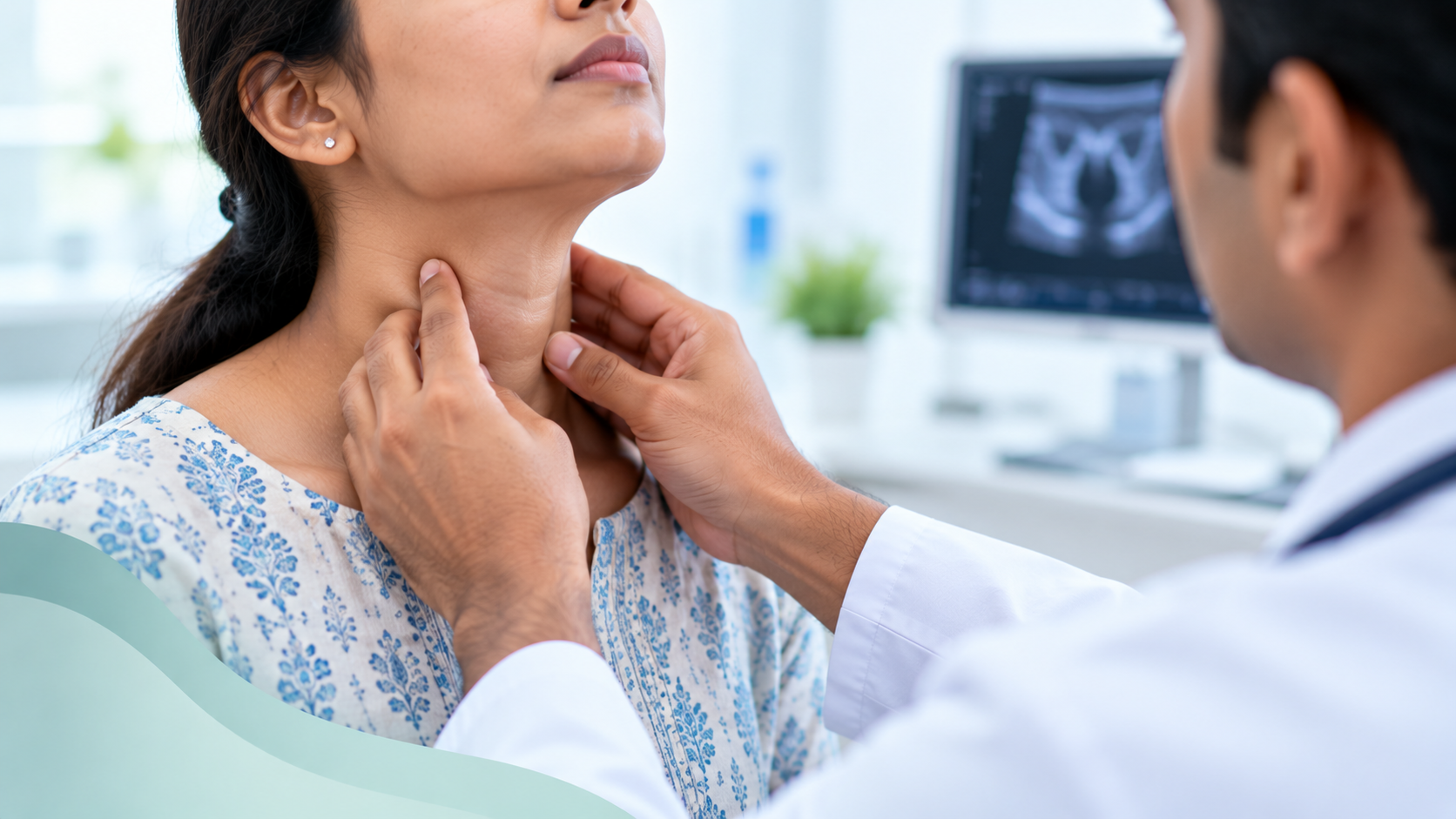
Many people first notice a thyroid swelling by accident, in a photograph, while buttoning a shirt collar, or when a relative points out a bulge in the neck. The immediate fear is often cancer, or that an operation will be unavoidable. In reality, most thyroid swellings are benign, and a large number never need surgery at all.
What matters is a clear evaluation: understanding what kind of swelling it is, whether the thyroid is working normally, and whether there are any features that need closer attention. This guide walks you through the causes, the tests that matter and the specific situations where surgery is advised.
The thyroid is a butterfly-shaped gland at the front of the neck, just below the Adam’s apple. It produces hormones that control metabolism, influencing energy levels, heart rate, body temperature, weight, and even hair and skin health. Any enlargement of the gland is called a goitre, whether or not the hormone levels are normal.
The whole gland enlarges evenly. This is often linked to iodine deficiency or autoimmune conditions such as Hashimoto’s thyroiditis or Graves’ disease.
The gland contains several lumps (nodules) of varying sizes. These develop slowly over years and are very common in middle-aged women.
A single lump in one part of the gland. Most solitary nodules are benign, but because a small proportion can be cancerous, they always deserve evaluation.
A fluid-filled nodule. Simple cysts are usually harmless, though they can enlarge suddenly if there is bleeding inside them.
Thyroid swellings are several times more common in women than in men, which is why women between 30 and 55 are the group most often seen with neck swelling.
Many thyroid swellings cause no symptoms other than the lump itself. Others come with clues that help the doctor understand what is happening:
| Symptom | What It May Suggest |
|---|---|
| Weight gain, tiredness, feeling cold, dry skin, constipation | An underactive thyroid (hypothyroidism) |
| Weight loss, palpitations, tremor, sweating, feeling hot | An overactive thyroid (hyperthyroidism) |
| Difficulty swallowing or a feeling of pressure in the neck | A large goitre pressing on the food pipe |
| Breathlessness, especially when lying flat | A goitre pressing on the windpipe or extending behind the breastbone |
| Hoarse voice lasting more than a few weeks | Needs prompt evaluation |
| A hard lump that is growing quickly | Needs urgent evaluation |
Thyroid imbalance is also a well-known cause of hair thinning. If you are noticing both, our guide on hair fall causes, including thyroid problems explains the connection.
A thyroid swelling is usually evaluated with a few straightforward tests:
No. Thyroid nodules are very common, and the great majority are benign. Only a small proportion, commonly estimated at around 5 to 10 percent of nodules that are evaluated, turn out to be cancerous. Even then, most thyroid cancers grow slowly and have excellent outcomes with timely treatment. This is why the goal is a calm, structured evaluation rather than panic or delay.
Depending on the test results, many patients are managed without an operation:
Surgery is usually advised in the following situations:
Thyroid surgery is done under general anaesthesia through an incision placed in a natural skin crease of the neck, so the scar usually fades well over time. Depending on the condition, the surgeon removes one lobe (hemithyroidectomy) or the whole gland (total thyroidectomy). Most patients stay in hospital for one to three days.
Two risks are discussed with every patient. The nerves that control the voice lie very close to the thyroid, so temporary hoarseness can occur, and permanent voice change is uncommon in experienced hands. After total thyroidectomy, the small parathyroid glands that control calcium can be temporarily affected, causing tingling in the fingers or around the lips, which is treated with calcium supplements. Patients who have the whole gland removed take a daily thyroid hormone tablet for life, while many patients who have only one lobe removed do not need one.
You can read more about our approach to thyroid swelling treatment in Tirupati, including evaluation and surgery.
A 42-year-old woman notices a swelling on one side of her neck in family wedding photographs. Her thyroid blood tests are normal. An ultrasound shows a 2 cm nodule, and FNAC reports it as benign. Instead of surgery, she is advised to repeat the ultrasound after a year. The nodule stays stable, and she continues with routine follow-up. For many people, this calm, step-by-step approach is exactly what thyroid care looks like.
Swellings in the neck can also come from lymph nodes, cysts or fatty lumps in the skin. A thyroid swelling typically moves up when you swallow, which helps the doctor tell them apart. If your lump is in the skin rather than the gland, our body lump removal page explains how such lumps are treated.
If you would like a personalised laser hair removal quote based on your specific skin and hair type, book a consultation with our dermatology team.
Good thyroid care starts with the right tests and an honest recommendation, including when surgery is not needed. Yutika Hospital’s general surgery team reviews your blood reports, ultrasound and FNAC results together, explains every option clearly, and performs thyroid surgery with careful attention to voice and calcium safety when it is truly needed.
A thyroid swelling deserves attention, not alarm. Most are benign and many can be managed with monitoring or medicines alone. The key is a proper evaluation with blood tests, ultrasound and, where needed, FNAC, followed by an honest discussion about whether surgery is needed.
If you have noticed a swelling in your neck, book a thyroid evaluation with our surgical team.
This article is intended for educational and informational purposes only and should not be considered medical advice, diagnosis, or treatment. Every individual’s health condition is unique. Always consult a qualified healthcare professional for personalized medical guidance. Do not ignore or delay seeking professional medical advice based on information provided in this article. If you are experiencing a medical emergency, seek immediate medical attention or contact your local emergency services.

Yutika Hospital is a trusted multi-speciality hospital in Tirupati offering advanced general surgery and dermatology treatments. We focus on accurate diagnosis, effective treatment, and personalized patient care.
Need more help?
Email support
2-120A, Rd Number 2, M.K. Naidu Colony, Lingeswar Nagar, Bairagi patteda, Tirupati, Andhra Pradesh 517501
Best Hospital in Tirupati for General Surgery & Dermatology Treatments
© 2026 Yutika Hospital, Tirupati. All Rights Reserved.