
Home » Safe Ear Piercing for Babies and Kids: What Every Parent Should Know
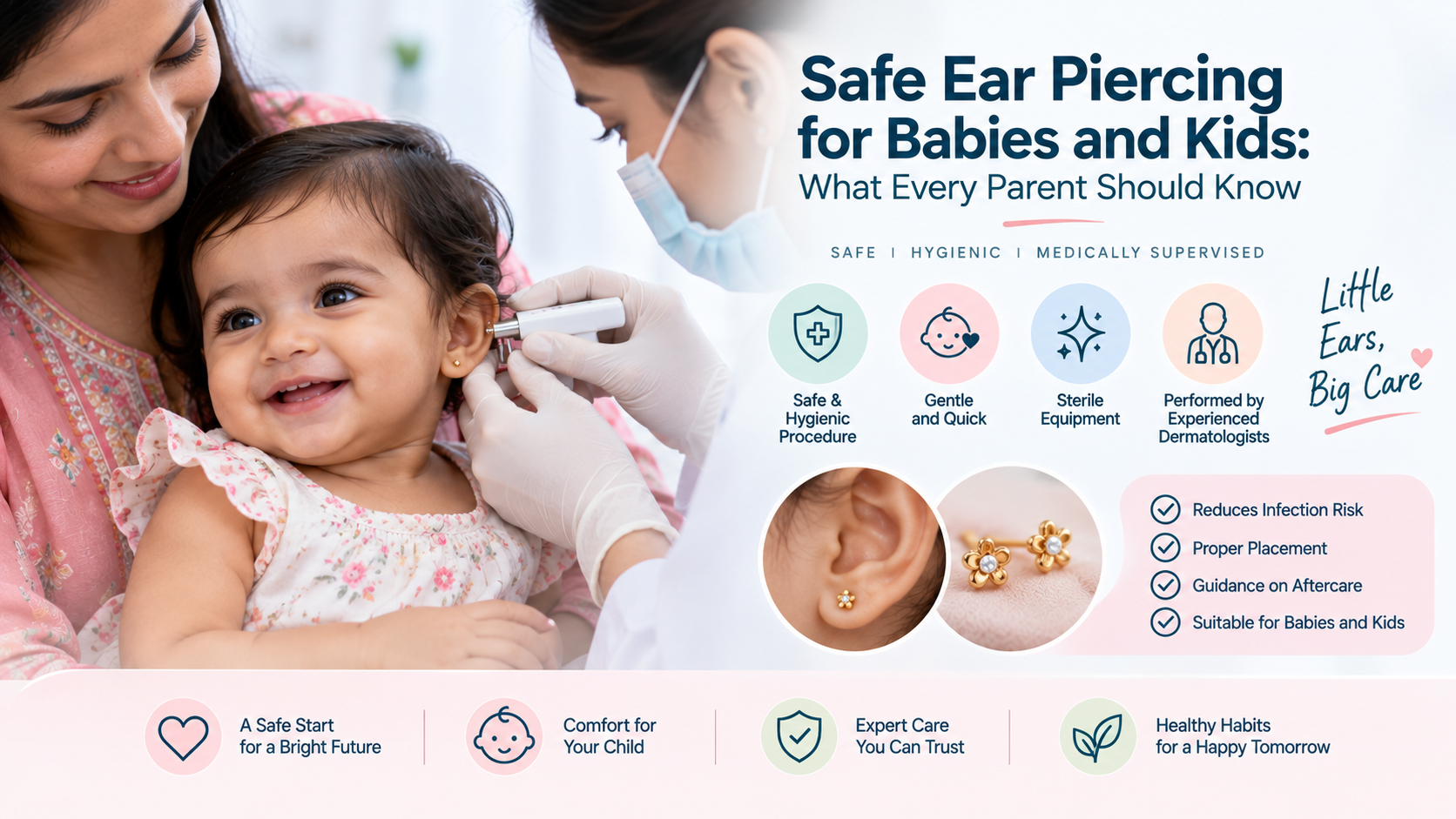
Ear piercing for babies and young children is a common tradition in many Indian families, often tied to specific ceremonies and family customs. It is also a genuine medical procedure, even though it is frequently treated casually, done at a jewellery shop or by a roadside vendor without much thought to hygiene. Understanding the real infection risks, and what a properly supervised piercing actually involves, helps you keep the tradition while protecting your child’s health.
There is no single universally required age, and this often depends on family tradition and ceremony timing. From a medical standpoint, most dermatologists suggest waiting until after a baby has had their initial vaccination series, and choosing a time when the child is healthy, rather than piercing during an illness or skin condition flare-up.
These risks are not rare or exaggerated. Infected ear piercings from unsterile equipment are one of the more common preventable skin concerns seen in young children, and the consequences, including scarring or keloid formation, can be long-lasting.
The procedure itself takes only a few minutes, but the difference in safety and long-term outcome compared to an unsterile setting is significant.
For babies and young children, the process is quick, and while there is a brief moment of discomfort, it typically passes within seconds. A professional setting also means the person performing the piercing has experience specifically with children, which makes the whole process a lot more calmer for both the child and parent.
Initial healing typically takes around four to six weeks, though full healing of the piercing channel can take a couple of months. During this period, the earring is usually left in place continuously rather than removed and reinserted, which could disrupt healing.
Dermatologist supervised treatment using hospital grade lasers costs more per session in many cases, but is matched to your specific skin type and monitored for safety throughout the course of treatment. You can learn more about our approach on the laser hair removal page.
Mild redness and slight tenderness in the first day or two is normal. Signs that suggest infection rather than normal healing include increasing redness spreading beyond the piercing site, yellow or green discharge, significant swelling, warmth to the touch, or fever. Any of these warrant prompt medical evaluation over waiting for it to improve on its own.
Nickel is a common cause of allergic reactions in ear piercings and is best avoided, particularly for a first piercing in a young child. Surgical-grade stainless steel, titanium, or gold are generally better tolerated and reduce the risk of an allergic skin reaction at the piercing site.
A family plans their baby’s ear piercing at a jewellery shop as part of an upcoming family ceremony, unaware that the piercing gun used has not been properly sterilized between customers. Within a few days, the piercing site becomes increasingly red, swollen, and starts discharging fluid, requiring a doctor’s visit and a course of treatment to resolve the infection, along with worry and discomfort for the baby that could have been avoided. A medically supervised piercing, using sterile, single-use equipment, carries none of this risk, while still allowing the family to keep their planned ceremony timing.
There is a brief moment of discomfort during the actual piercing, similar to a quick pinch, which typically resolves within moments. Babies generally settle quickly afterward, and the brief discomfort is far preferable to the more significant pain and disruption an infection would cause later.
Gentle bathing can continue as normal, but it is worth being mindful of directly soaking or scrubbing the piercing site during the initial healing weeks, and drying the area gently afterward rather than leaving it damp.
Some individuals are more prone to keloid formation, a raised thickened scar that can develop at piercing sites. This tendency can run in families. The same principle of choosing a properly trained, sterile setting applies to other minor skin procedures too, such as removing a wart or skin tag with cryotherapy rather than at home. If there is a known family history of keloids, mentioning this beforehand allows for appropriate discussion about technique and monitoring during healing.
If you would like a personalised laser hair removal quote based on your specific skin and hair type, book a consultation with our dermatology team.
Ear piercing for a baby or young child deserves the same hygiene standards as any other minor medical procedure, not the inconsistent conditions of an unsterile roadside setting. Yutika Hospital offers ear piercing using sterile, single-use equipment and hypoallergenic studs, along with clear aftercare guidance, so families can keep their tradition without the preventable infection risk. Learn more on our safe ear piercing page.
Ear piercing is an important tradition for many families, and there is no need to choose between honoring that tradition and protecting your child’s health. A properly sterile, medically supervised piercing, using the right equipment and hypoallergenic studs, lets you continue the custom while avoiding the genuinely preventable infection risks of an unsterile setting.
If you are planning your child’s ear piercing, book an appointment with our team for a safe, hygienic procedure.
This article is intended for educational and informational purposes only and should not be considered medical advice, diagnosis, or treatment. Every individual’s health condition is unique. Always consult a qualified healthcare professional for personalized medical guidance. Do not ignore or delay seeking professional medical advice based on information provided in this article. If you are experiencing a medical emergency, seek immediate medical attention or contact your local emergency services.

Yutika Hospital is a trusted multi-speciality hospital in Tirupati offering advanced general surgery and dermatology treatments. We focus on accurate diagnosis, effective treatment, and personalized patient care.
Need more help?
Email support
2-120A, Rd Number 2, M.K. Naidu Colony, Lingeswar Nagar, Bairagi patteda, Tirupati, Andhra Pradesh 517501
Best Hospital in Tirupati for General Surgery & Dermatology Treatments
© 2026 Yutika Hospital, Tirupati. All Rights Reserved.